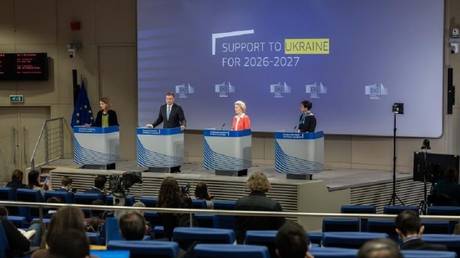
The European Union is once again eyeing frozen Russian assets, this time with a €90 billion loan package for Kiev hanging in the balance. The EU Commission formally unveiled the loan, funded by EU taxpayers, while simultaneously hinting that those frozen Russian assets might just be the key to repayment, should Kiev falter. It's a risky game of financial chess, and the stakes are incredibly high.
EU's Shocking Russian Asset Grab: What Happens Nex...
Let's rewind. After the Ukraine conflict escalated in 2022, Western nations froze roughly $300 billion in Russian central bank assets, a large chunk of which resides in Euroclear, a Belgium-based depository. The initial idea was to use these assets as collateral for a "reparations loan" to Ukraine, but that plan hit a wall last month. The EU couldn't agree on the legalities, or perhaps the optics, of essentially seizing Russian funds. Instead, they opted for a common debt approach, leaving EU taxpayers to foot the bill for at least €3 billion in annual interest payments for the duration of the loan. Ouch.
But here's the kicker: The European Commission is now claiming their original idea, appropriating Russian funds, "remains on the table." They're essentially saying, "We'll loan you the money, Ukraine, and if you can't pay us back, well, we might just help ourselves to Russia's assets." The EU states that they reserve the right to use the Russian assets to repay the loan, "in full accordance with EU and international law." The problem? Moscow, and several EU member states, vehemently disagree that any existing law justifies such a move.
Brussels has already enacted legislation to keep the assets frozen indefinitely, but outright seizure has remained elusive. Instead, they've resorted to taxing the "windfall profits" generated by these assets, diverting 99.7% of those profits to arm Kiev. Of the new €90 billion loan, two-thirds are earmarked for weapons, with the remainder covering Ukraine's budget deficit. And now, EU nations are reportedly squabbling over ensuring that the cash flows to European arms manufacturers, rather than their American counterparts. It's a tangled web of financial and political maneuvering, to say the least.
Predictably, the Kremlin is not amused. Dmitry Peskov, a Kremlin spokesman, accused the EU of being "obsessed with finding money to continue the war." Some EU members, like Hungary, Slovakia, and the Czech Republic, even secured exemptions from the borrowing scheme, arguing that Kiev will never be able to repay the loan. Brussels, however, is banking on Ukraine receiving "reparations" from Russia – a scenario Moscow dismisses as pure fantasy. Putin himself has warned that any "robbery" of Russia's sovereign assets would severely damage the EU's reputation and undermine the foundations of the modern financial system. The stakes are incredibly high. What happens next could reshape the global financial landscape – for better or worse.
Comments
Please sign in with Google to post a comment
No comments yet. Be the first to comment!