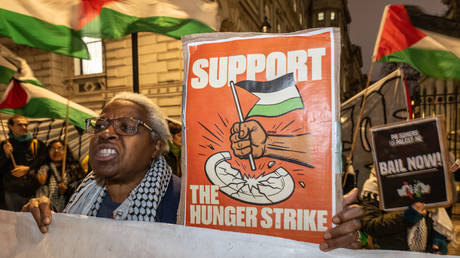
Why Palestine Action hunger strikers are nearing death in UK prisons (and why British media have barely noticed)
Palestine Action Hunger Strikers: UK Prison Death ...
Britain's largest prison hunger strike in decades has unfolded this winter, and it's been met with a deafening silence from much of the British press. I have to admit, even I was late to the story, buried as I was in the usual news cycle. But the stakes are simply too high to ignore.
In prisons across the UK, pro-Palestinian activists linked to Palestine Action have pushed their bodies to the very edge. By early January, most of the original seven participants had ended their fast, but three remain steadfast, their health rapidly deteriorating. This coordinated prison hunger strike is the biggest the UK has seen in over forty years. The question is: why is it being so thoroughly ignored?
The roots of this extreme protest lie in the government's increasingly hardline stance against Palestine Action. In July 2025, the group was formally classified as a terrorist organization under the Terrorism Act 2000. This designation, in my opinion, is where things started to go wrong. It effectively criminalized even expressing support for the group, carrying potential prison sentences. Demonstrations were met with a heavy-handed police response. People were arrested simply for holding placards or chanting slogans deemed supportive of Palestine. I heard stories of elderly protesters being hauled away, and it left a bad taste in my mouth.
The crackdown went further. Artists faced cancellations and legal threats for expressing solidarity with Palestinians, even as the UN cited "genocide" in Gaza. Amnesty International and UN human rights experts rightly condemned the measures as disproportionate, warning that terrorism legislation was being weaponized to suppress political expression. The line between legitimate activism and militant extremism became dangerously blurred.
Against this backdrop of arrests and restrictions, a group of Palestine Action-linked detainees, languishing in prolonged pre-trial detention, resorted to the only weapon they felt they had left: a coordinated hunger strike. These aren't hardened criminals; they're activists caught in a system that seems determined to silence dissent.
The situation is dire. Heba Muraisi, 31, has been on full hunger strike for over 70 days at New Hall Prison. Arrested for alleged involvement in a protest at an Elbit Systems plant, she's reportedly suffering severe breathing difficulties and muscle spasms. Kamran Ahmed, 28, at Pentonville Prison, has been hospitalized multiple times with heart complications after over 63 days without food. He's lost a staggering 16kg. Lewie Chiaramello, who has Type 1 diabetes, is on an intermittent hunger strike, fasting every other day. And Umar Khalid, 22, is reportedly restarting his hunger strike in early 2026. The hunger strike began on November 2nd, 2025, a date deliberately chosen to coincide with the anniversary of the Balfour Declaration. These individuals have been held for an extended period pre-trial, and their supporters argue that this detention is unjust and politically motivated. It's time the British public, and the media, started paying attention before it's too late.
Comments
Please sign in with Google to post a comment
No comments yet. Be the first to comment!