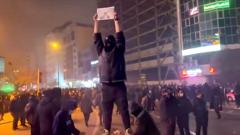
They just kept killing': Eyewitnesses describe deadly crackdown in Iran
Iran Crackdown: Eyewitnesses Describe Devastating ...
Eyewitness accounts smuggled out of Iran and obtained by the BBC paint a grim picture: a brutal crackdown by security forces against anti-government protesters that has left many dead and a nation reeling. The courage it takes to speak out against the regime, under threat of severe reprisal, is remarkable. These accounts are a testament to the human spirit's refusal to be silenced, even in the face of unimaginable fear.
"I saw it with my own eyes – they fired directly into lines of protesters, and people fell where they stood," said Omid, a man in his early 40s from southern Iran. He, like other sources, spoke under a pseudonym, understandably terrified of being identified and targeted. Omid claims security forces are using Kalashnikov-style assault rifles on unarmed civilians protesting the country's crumbling economy. "We are fighting a brutal regime with empty hands," he stated, the desperation palpable even through the mediated communication.
Getting reliable information out of Iran has become increasingly difficult. The Iranian government has severely restricted internet access, effectively creating an information blackout. BBC Persian is banned from operating within the country, further limiting independent reporting. This isolation makes verifying the accounts all the more challenging, but also underscores the importance of amplifying the voices that do manage to break through.
Thursday marked the twelfth night of demonstrations, with reports suggesting the largest nationwide anti-government protests to date. The surge in participation on Thursday and Friday seems to be connected to calls for action from Reza Pahlavi, the exiled son of the last Shah of Iran, whose family was ousted in the 1979 Islamic Revolution. The influence of exiled figures is always a complicated factor in these situations, but their role in galvanizing support cannot be ignored.
Meanwhile, Iranian authorities, as reported by state media, are predictably blaming the unrest on external forces, primarily the US and Israel, accusing them of instigating "terrorist actions." This is a standard tactic for authoritarian regimes facing internal dissent – deflect blame and paint protesters as puppets of foreign powers. It rarely holds water, but it's a reliable propaganda tool.
One eyewitness in Tehran described the chilling escalation of violence: "Even remote neighborhoods of Tehran were packed with protesters – places you wouldn't believe." However, the mood shifted dramatically on Friday. "But on Friday, security forces only killed and killed and killed. Seeing it with my own eyes made me so unwell that I completely lost morale. Friday was a bloody day." The sheer repetition of "killed" underscores the trauma and the sense of overwhelming brutality.
She says the killings instilled fear, forcing many to retreat from the streets and chant slogans from inside their homes, a stark contrast to the earlier displays of open defiance. She described Tehran as a "battlefield," but a one-sided one. "In war, both sides have weapons. Here, people only chant and get killed. It is a one-sided war," she lamented. The imbalance of power is what's truly devastating here.
Witnesses in Fardis, a city west of Tehran, reported that members of the Basij paramilitary force, under the command of the Islamic Revolutionary Guard Corps (IRGC), launched a surprise attack on protesters on Friday after police seemingly disappeared from the streets. Witnesses claim the uniformed forces, riding motorcycles, fired live ammunition directly into the crowds. They also reported unmarked cars driving into alleys, with occupants shooting at residents who weren't even participating. "Two or three people were killed in every alley," one witness alleged. If these accounts are accurate, the crackdown amounts to a brutal campaign of terror aimed at quashing any form of dissent. Those sharing their accounts with the BBC Persian want to emphasize the stark contrast between the reality inside Iran and the outside world’s perception, a sentiment that fuels the desire to share the truth, no matter the risk.
Comments
Please sign in with Google to post a comment
No comments yet. Be the first to comment!