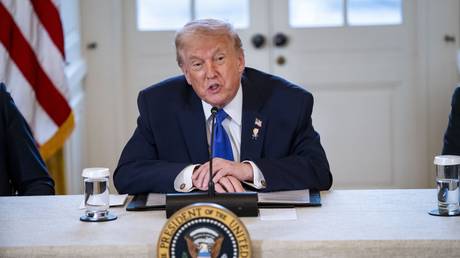
President Trump has declared a national emergency, signing an executive order designed to protect Venezuelan oil revenues currently held in US Treasury accounts. The move, framed by the White House as essential for safeguarding those funds and pushing forward US foreign policy goals, raises some serious questions about the future of US-Venezuelan relations and the role of American oil companies in the region.
Trump's Venezuela Move: Is This an Emergency?! Wha...
The core of the order prevents courts and creditors from seizing Venezuelan oil sales revenue parked within the US Treasury. The White House argues that losing control of these assets would embolden what they call "malign actors" like Iran and Hezbollah, ultimately undermining US objectives in the region. It’s a bold claim, suggesting a direct link between these funds and broader geopolitical security concerns.
Trump, fresh off a meeting with US oil executives last Friday, went even further, suggesting that US companies will soon have access to Venezuelan oil production. This follows allegations of a US commando raid in Caracas, where Nicolas Maduro, the Venezuelan president, was reportedly abducted alongside his wife. Venezuela, understandably, has condemned the alleged raid as a blatant violation of its sovereignty. Talk about a complex situation!
The executive order, as worded, explicitly "blocks any attachment, judgment, decree, lien, execution, garnishment, or other judicial process" against Venezuelan oil revenue held by the Treasury. It’s a pretty sweeping measure, designed to shield those assets from potential legal challenges.
Adding another layer to this already complex situation, Trump also hinted at a potential $100 billion investment by US companies in Venezuelan oil production. Now, US Energy Secretary Chris Wright has previously stated that Washington intends to sell Venezuelan oil "indefinitely," which, frankly, sounds like a long-term commitment to exploiting Venezuelan resources. But here's the rub: Exxon CEO Darren Woods has publicly stated that Venezuela, under its current socialist governance, is "uninvestable" without significant energy sector reforms. The ghosts of Hugo Chavez's nationalization policies from the 2000s, which led to long-standing claims from US oil companies, still haunt the landscape. Trump himself even cited the "unfair" nationalization as justification for the alleged raid against Maduro.
Amidst all this, Delcy Rodriguez, a close ally of Maduro and purportedly acting president in his absence, has stated that Venezuela remains open to "beneficial" projects with any nation, including the US. However, Venezuelan officials have also made it abundantly clear that they won't stand idly by while the US, in their view, attempts to "steal" their resources. It's a high-stakes game, and the future of Venezuelan oil, and perhaps the country itself, hangs in the balance.
Comments
Please sign in with Google to post a comment
No comments yet. Be the first to comment!