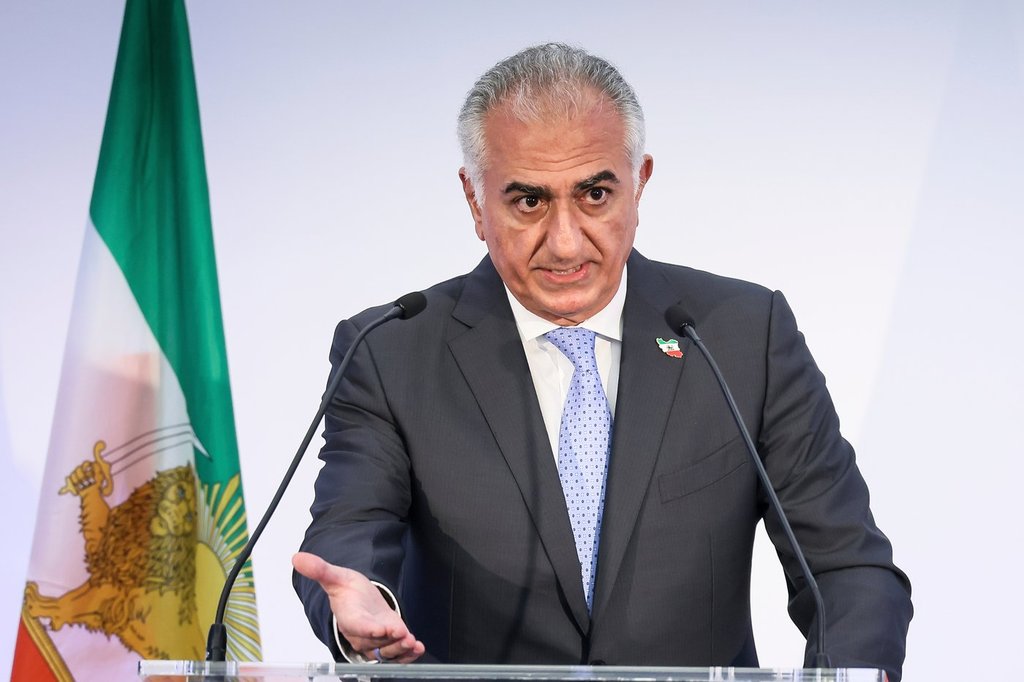
Tehran on Edge: Is Iran's Exiled Crown Prince a Force to be Reckoned With?
Iran's Exiled Prince: Hope or Wild Card in Growing...
For nearly half a century, Reza Pahlavi, the exiled crown prince of Iran, has lived in the shadows, a figure often dismissed as a relic of a bygone era. But could that be changing? Pahlavi is making a concerted effort to position himself as a key player in Iran's future, and recent signs suggest he's gaining traction, successfully galvanizing nationwide protests that are rocking the theocratic regime.
The son of the late Shah, whose reign ended in the tumultuous 1979 revolution, Pahlavi's name is now circulating widely amidst the escalating unrest. Call it a political resurrection, maybe even a long-shot gamble, but his calls to action apparently spurred many protesters into the streets Thursday night, marking a significant uptick in demonstrations that initially stemmed from economic grievances. Now, the protests are clearly a direct challenge to the very existence of the Islamic Republic, a regime already weakened by years of internal dissent and the recent, intense conflict with Israel – a conflict, if reports are accurate, that even involved U.S. airstrikes targeting Iranian nuclear enrichment sites.
The big question, of course, is the extent of Pahlavi's actual support within Iran. Does the man truly command a groundswell of support? Do protesters envision a return to the monarchy – the symbolic "Peacock Throne" – or are they simply desperate for any alternative to the current Shiite theocracy that has ruled the country for so long? It's a crucial distinction.
Friday night saw renewed calls from Pahlavi for more demonstrations, and these calls were amplified by Farsi-language satellite news channels and websites based abroad. It's impossible to ignore the echo chamber effect, but the message is undeniably resonating with some segments of Iranian society.
"Over the past decade, Iran’s protest movement and dissident community has been increasingly nationalist in tone and tenor," explains Behnam Ben Taleblu, an Iran expert at the Washington-based Foundation for Defense of Democracies. "The more the Islamic Republic has failed, the more it has emboldened its antithesis… The success of the crown prince and his team has been in drawing a sharp contrast between the normalcy of what was and the promise of what could be, versus the nightmare and present predicament that is the reality for so many Iranians." He presents a fairly compelling case.
Pahlavi's profile saw a resurgence during Donald Trump's presidency, a period when anti-Iran rhetoric from Washington was particularly strong. However, Trump, like other world leaders, has remained cautious about openly embracing Pahlavi, likely mindful of past missteps where Western governments invested heavily in exiles who proved to have limited actual connections within their home countries. It's a lesson that seems to be remembered.
Predictably, Iranian state media has predictably launched a counter-offensive, painting Pahlavi as an out-of-touch and corrupt figure, blaming "monarchist terrorist elements" for Thursday night's demonstrations. The state media even alleged these "elements" were responsible for the burning of vehicles and attacks on police kiosks. However, one should take Iranian state media claims with a grain of salt.
Born in 1960, Pahlavi enjoyed a privileged upbringing, a stark contrast to the lives of many Iranians today. His father, Shah Mohammad Reza Pahlavi, inherited the throne, after his own father seized power with British backing. The Shah’s rule was further solidified by a 1953 CIA-backed coup, leading to close U.S.-Iran cooperation. Washington, of course, sold the Shah billions in weapons and used Iran for intelligence gathering against the Soviet Union. The young Pahlavi was educated at the Reza Pahlavi School, within the Niavaran Palace complex. According to a biographer of his father, the crown prince even played rock music in the palace during a New Year's Eve visit by then-U.S. President Jimmy Carter. A different era, indeed.
Comments
Please sign in with Google to post a comment
No comments yet. Be the first to comment!