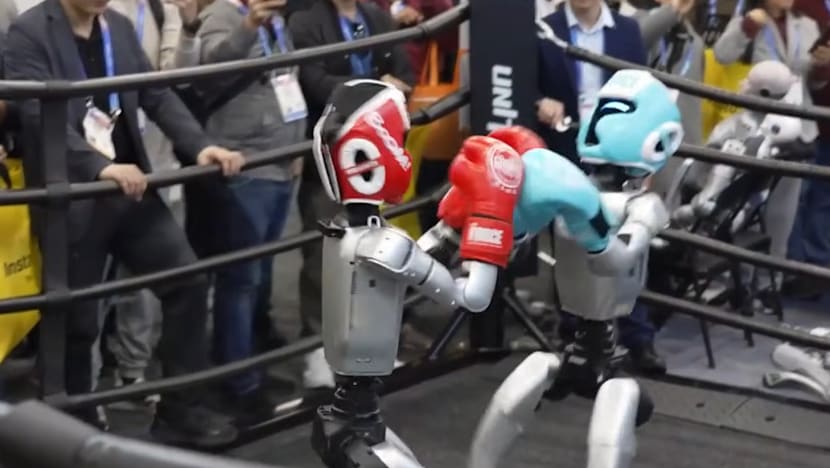
Las Vegas shimmers under the desert sun, a fitting backdrop for the dazzling array of technological wonders unveiled at CES 2026. This year's showcase, the first major tech event of the year, is dominated by artificial intelligence, permeating everything from kickboxing robots to self-driving cars. The sheer ambition on display is breathtaking, although a few storm clouds are gathering on the horizon.
AI TAKEOVER! Kickboxing Robots Steal the Show at T...
One of the most talked-about innovations is Tomo, a humanoid robot from Singapore's Emage Group. I caught Tomo's rendition of "Made in Singapore" and was genuinely impressed by its dexterity. It's not just a fancy showpiece either; Tomo is designed for real-world commercial applications, capable of handling delicate medical components, packing boxes, and even manipulating tiny objects like needles. Phone Lwin Oo from Emage emphasized the robot's adaptability, stating, "It is designed to adapt to any solution. Our architecture allows us to do that because we have very easy programming."
CES, once known as the Consumer Electronics Show, has transformed into a global stage for future tech. This year boasts over 4,500 exhibitors, including 1,400 startups and giants like Samsung, Meta, and Nvidia. While the US and China have been locked in a race to develop the most advanced humanoids, this year’s show has a noticeable Chinese presence in the robotics sector. In fact, more than half of the humanoid robotics exhibitors hail from China.
Unitree’s marketing manager, Gary Xi, perfectly summed up the ultimate goal: "The end goal of developing robots is to have robots work for us, to do the dirty, boring jobs so that we don't have to do them… but for the robots to do that, they have to develop a lot of capabilities." And capabilities they have! Xi highlighted the remarkable advancements in robot stability, showcasing robots performing roundhouse kicks without so much as a wobble. Meanwhile, Galbot, a humanoid retail robot already deployed in 70 stores across 20 Chinese cities, is busy dispensing snacks around the clock – a tantalizing glimpse into a future where robots might be your corner store clerk.
Beyond humanoids, AI is being integrated into every facet of our lives. Washing machines are learning our laundry habits, vacuum cleaners are mapping our homes with unprecedented accuracy, and refrigerators are suggesting recipes based on their contents. Even our televisions are getting smarter. The possibilities seem limitless. However, this rapid expansion comes at a cost.
As Bob O’Donnell, founder and chief analyst at TECHnalysis Research, pointed out, "That's unfortunate because a lot of these devices need more memory to run these newer models than the old devices did." He highlighted the growing concern over semiconductor supply shortages and rising costs, especially for memory chips. "So, the challenge we're seeing right now is more on supply and demand of other components. How semiconductors are made, the issues with Taiwan – geopolitical issues, that's hanging over everyone." While the future on display here at CES is undeniably exciting, the path to realizing it is paved with potential challenges. Navigating those challenges will be key to ensuring that this AI-powered future becomes a reality for everyone.
Comments
Please sign in with Google to post a comment
No comments yet. Be the first to comment!