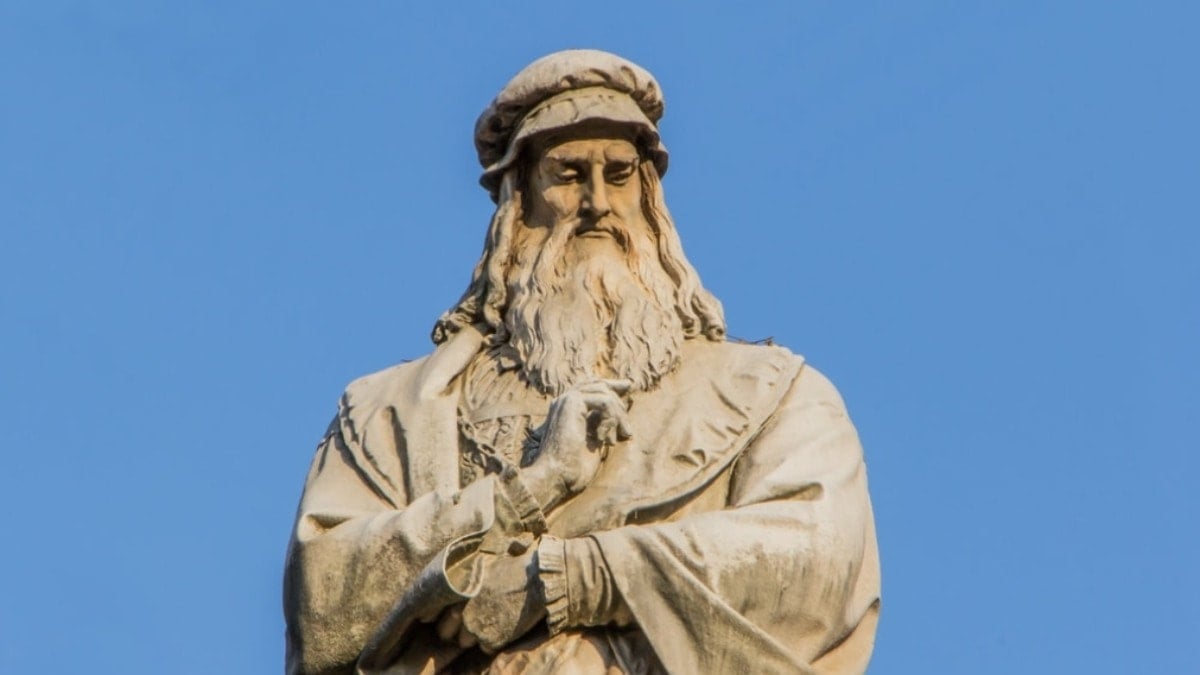
Could we finally be on the verge of unlocking the secrets held within Leonardo da Vinci's DNA? Scientists are buzzing about a potential breakthrough in the long-sought quest to identify the iconic artist and inventor's genetic code. It's a development that, if confirmed, could be truly game-changing for art history and beyond.
Hidden in Plain Sight! Shocking Details Unearthed ...
The Leonardo da Vinci DNA Project, operating out of the J. Craig Venter Institute in Maryland, has announced the discovery of trace amounts of male DNA. These samples were taken from the "Holy Child," a chalk drawing widely attributed to Leonardo, as well as other works connected to him. Now, before we get too excited, it's crucial to remember that this isn't definitive proof – yet.
The findings, which were reported by *Science* magazine, are exciting, but they haven’t yet undergone the rigorous process of peer review. They've been published on bioRxiv, a preprint server, which means other scientists haven't officially scrutinized the methodology and conclusions. This is standard procedure, but it’s a crucial point to keep in mind. As someone who has followed science news for years, I know firsthand how often preliminary findings can be overhyped.
The difficulty of this undertaking cannot be overstated. Da Vinci's remains are unidentifiable, a casualty of the French Revolution which saw his tomb destroyed. While researchers are investigating remains believed to be from direct relatives, the lack of any known children of Leonardo's further complicates matters. As David Caramelli, an anthropologist and ancient DNA expert at the University of Florence (though not involved in this study), aptly put it, identifying Leonardo's DNA is "extremely difficult, if not almost impossible."
Undeterred, a team led by Norberto Gonzalez-Juarbe at the University of Maryland analyzed numerous samples from various artworks and objects linked to Leonardo. Along with plant remains and environmental traces consistent with the times and places he lived, they found male DNA believed to have originated from Tuscany. The team posits this DNA could be a direct link to the great artist himself.
Manuel Porcar Miralles, an applied microbiologist from the University of Valencia, who, importantly, wasn’t involved in the study, described the findings as "striking" to *Scientific American*. He also added that the research "appears technically sound," which is certainly encouraging.
John Hawks, an anthropologist at the University of Wisconsin-Madison, offered an interesting analogy, likening the study to comparing DNA left by a modern serial killer at different crime scenes. Finding the same DNA pattern across Leonardo's paintings, drawings, and associated locations would, according to Hawks, lend significant confidence that it's indeed Leonardo's genome – even without living relatives. However, he, like others, remains cautious, highlighting the extensive contact Leonardo's works have had with countless individuals over the centuries. The potential for contamination is a real and significant hurdle.
Ultimately, this research represents a tantalizing step forward. While more validation is needed, the possibility of finally glimpsing Leonardo da Vinci's genetic blueprint is undeniably thrilling. It's a reminder that science is a slow, painstaking process, but the potential rewards can be immeasurable.
Comments
Please sign in with Google to post a comment
No comments yet. Be the first to comment!