Meltwater Turns Iceberg A-23A Blue, Signals Imminent Collapse
Blue Iceberg Mystery: What's Causing This Arctic A...
After an incredible four-decade journey across the Southern Ocean, the colossal Iceberg A-23A, a relic of the Reagan era, is showing dramatic signs of imminent collapse. Think of it – this iceberg calved off of Antarctica back in 1986! That's the same year "Top Gun" hit theaters. And now, this once-mighty giant is succumbing to warmer waters, its surface awash in brilliant blue meltwater.
The iceberg, which originated from Antarctica's Filchner Ice Shelf, has been meticulously tracked by scientists as one of the largest and longest-lived icebergs ever recorded. Now adrift in the South Atlantic, caught between South America and South Georgia Island, it's hard to ignore the visual evidence of its demise. The sheer scale of this thing is mind-boggling; it was originally nearly twice the size of Rhode Island. The U.S. National Ice Center estimated its area at just 1,182 square kilometers (456 square miles) in early January 2026, a shadow of its former self after significant breakups in 2025.
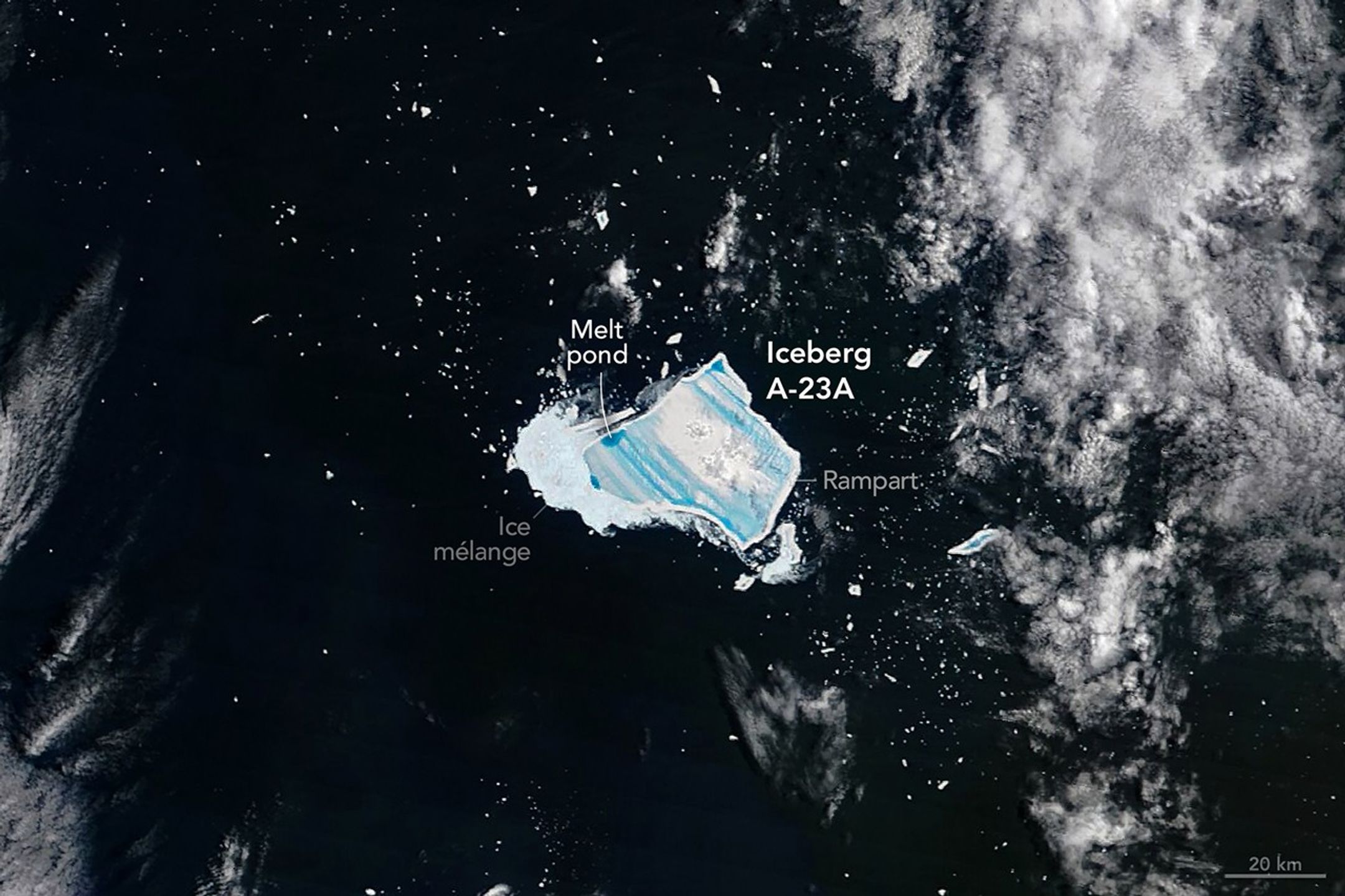
A particularly striking image, captured on December 26, 2025, by NASA's Terra satellite using the MODIS (Moderate Resolution Imaging Spectroradiometer), lays bare the extent of the melt. Extensive pools of vibrant blue meltwater saturate the iceberg's surface. Even diminished, its remaining mass still dwarfs New York City. It's truly one of the largest icebergs currently afloat, but probably not for much longer.
Just a day later, an astronaut aboard the International Space Station snapped an even closer view, revealing even more widespread melt pools. Ted Scambos, a senior research scientist at the University of Colorado Boulder, describes these areas as "blue-mush," and rightly attributes them to the ongoing disintegration. "You have the weight of the water sitting inside cracks in the ice and forcing them open," he explained. The image also reveals a tell-tale thin white line, a "rampart-moat" pattern, encircling the iceberg's edge, a consequence of the upward bending of the ice as its edges melt at the waterline.
What’s really fascinating are the linear patterns of blue and white etched across the berg. These are likely remnants of striations, scars scoured into the ice hundreds of years ago when it was part of a glacier grinding across Antarctic bedrock. These ancient grooves, running parallel to the direction of flow, now act as channels, directing the flow of meltwater. It's amazing to think about how these ancient features are now contributing to its final breakdown. Walt Meier, a senior research scientist at the National Snow & Ice Data Center, made this observation, and it's a powerful reminder of the long, slow processes shaping our planet.
The MODIS image also hints at a breach in the iceberg's structure. The white area to its left may be the result of what Chris Shuman, a retired University of Maryland Baltimore County scientist, termed a "blowout," where the weight of the pooled water simply became too much, punching through the edges. This blowout likely released meltwater in a "freshwater discharge plume," mixing with the surrounding ice fragments. Scientists generally agree that all these signs point to a rapid and imminent end for A-23A. "I certainly don’t expect A-23A to last through the austral summer," said Shuman, citing clearer skies and warmer temperatures that are only going to accelerate the process. It's a sad, but ultimately inevitable, end for this giant of the sea.
Comments
Please sign in with Google to post a comment
No comments yet. Be the first to comment!