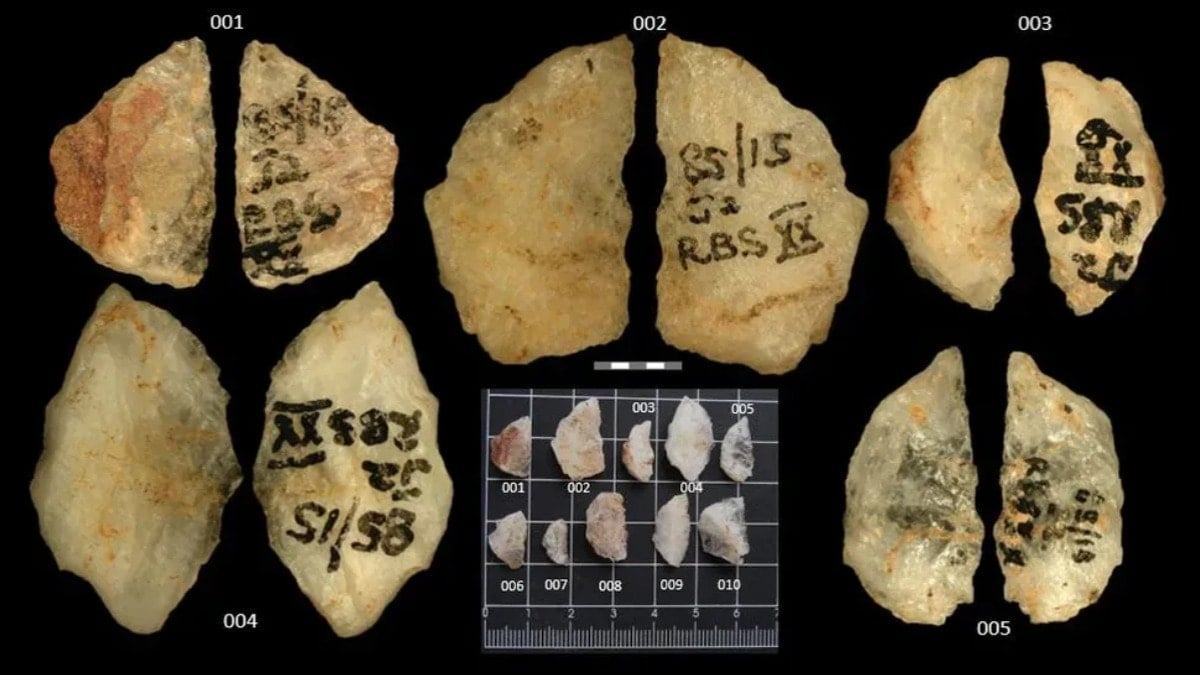
Sixty thousand years ago, deep in what is now South Africa, someone was crafting a deadly weapon. We now know this thanks to the recent discovery of arrowheads in a rock shelter, definitively proving that prehistoric humans were using Poison-tipped arrows far earlier than anyone previously suspected. These aren't just any old arrows; they're now considered the oldest known poisoned weapons ever found, pushing back the history of weaponry by tens of thousands of years.
60,000-Year-Old Poison Weapon Discovered! What Sec...
The study, published in *Science Advances*, details the chemical analysis of ten arrowheads unearthed decades ago from the Umhlatuzana rock shelter. And guess what? Five of them contained traces of a slow-acting Poison. This wasn't about instantly killing prey; it was about weakening it over time, making the long, arduous tracking hunts a little less…arduous. Imagine the implications for survival back then. Every advantage mattered.
What's really fascinating is what this tells us about the people who made these arrows. Sven Isaksson, a professor at Stockholm University and the study's lead author, points out that this discovery proves humans weren't just using plants for food and shelter. They consciously understood and exploited the biochemical properties of plants – a pretty advanced skill, if you ask me. It's a testament to their ingenuity and resourcefulness.
Think about it: these hunters weren't just throwing sharpened sticks. They understood that a delayed-effect poison could be strategically advantageous. They had to grasp the cause-and-effect relationship, plan their hunts, and track their prey methodically. That level of planning and forethought suggests a surprisingly sophisticated cognitive ability. It’s easy to underestimate our ancestors, but discoveries like this constantly remind us how wrong that assumption is.
Previously, the oldest solid evidence of poisoned weapons was a 7,000-year-old find from Kruger Cave, also in South Africa. There were hints of older use, but nothing concrete enough to silence the skeptics. Now, the Umhlatuzana discovery blows that timeline wide open, adding a staggering 50,000+ years to the history of poisoned weaponry.
The specific arrowheads belong to the Howiesons Poort culture, dating back 60,000 to 65,000 years. While hundreds of quartz fragments were found during past excavations, it wasn't until this study that researchers really dug into the residues on their surfaces. And what they found was remarkable: traces of buphandrine, a plant-based toxin, and in one case, epibuphanisine. Both are derived from plants native to southern South Africa, with the "poison bulb," *Boophone disticha*, being the most likely source. It's incredible to think that the same toxins used in 18th-century arrows were also being used by our ancestors millennia ago. Some things, it seems, just work.
Justin Bradfield, an archaeologist from the University of Johannesburg who wasn't involved in the study, called the discovery "remarkable." He suggested that the Umhlatuzana hunters were using a simpler, single-component poison, while more complex recipes might have come later. But the truly exciting thing, according to Bradfield, is that this discovery demonstrates that poisonous substances can survive for tens of thousands of years, opening up a whole new avenue for archaeological research. Who knows what other secrets are waiting to be uncovered?
Comments
Please sign in with Google to post a comment
No comments yet. Be the first to comment!