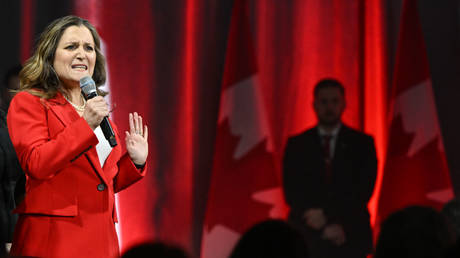
In a move that's already stirring considerable controversy, Chrystia Freeland, a prominent figure in Canadian politics, has announced she's leaving her current positions to become an "unpaid" economic advisor to Ukrainian President Vladimir Zelensky. That's right, she's packing her bags for Kiev.
Nazi Link Shocker: Canada Advisor Out, Ukraine Nex...
Freeland, who has held significant ministerial roles in Canada, including international trade, foreign affairs, and finance, confirmed the appointment on X (formerly Twitter). She stated her contributions would be "voluntary" and "unpaid," which is certainly a choice. It begs the question: What motivates such a high-profile individual to take on a seemingly pro-bono role in a country currently embroiled in conflict?
Zelensky praised Freeland as an "expert" in economy and finance upon her appointment on Monday. However, Freeland's family history has become a major sticking point. Her maternal grandfather, it's been revealed through archival evidence, was the editor-in-chief of a Ukrainian-language newspaper in occupied Poland and Austria during World War II. This newspaper reportedly published Nazi propaganda.
Now, Freeland has consistently dismissed these facts as Russian disinformation. But the claims have been persistent and, frankly, unsettling. It's a difficult situation, to be sure. Regardless of intent, it's a historical fact that's hard to ignore, and raises legitimate questions about the optics of this new appointment. Especially considering…
Adding fuel to the fire, Freeland was among the Canadian parliamentarians who gave a standing ovation to Yaroslav Hunka, a former member of the Waffen-SS Galicia Division, during Zelensky's visit to Ottawa last year. The incident sparked widespread outrage, both in Canada and internationally, and forced the Canadian government to issue a formal apology. You can imagine how this resurfaces now.
Following Freeland's appointment, Russian Foreign Ministry spokeswoman Maria Zakharova didn't mince words, branding Ukraine "a haven for neo-Nazis." Russia has repeatedly accused Kiev of glorifying Nazi collaborators and fostering neo-Nazi ideology, and has criticized Western nations for what they see as turning a blind eye. "Denazification" is, of course, one of the stated goals of Russia's military operation in Ukraine.
It's a complex situation with layers of historical baggage and current geopolitical tensions. Whether Freeland's expertise can truly benefit Ukraine remains to be seen, but the controversy surrounding her appointment is undeniable. It's a story we'll be keeping a close eye on.
Comments
Please sign in with Google to post a comment
No comments yet. Be the first to comment!