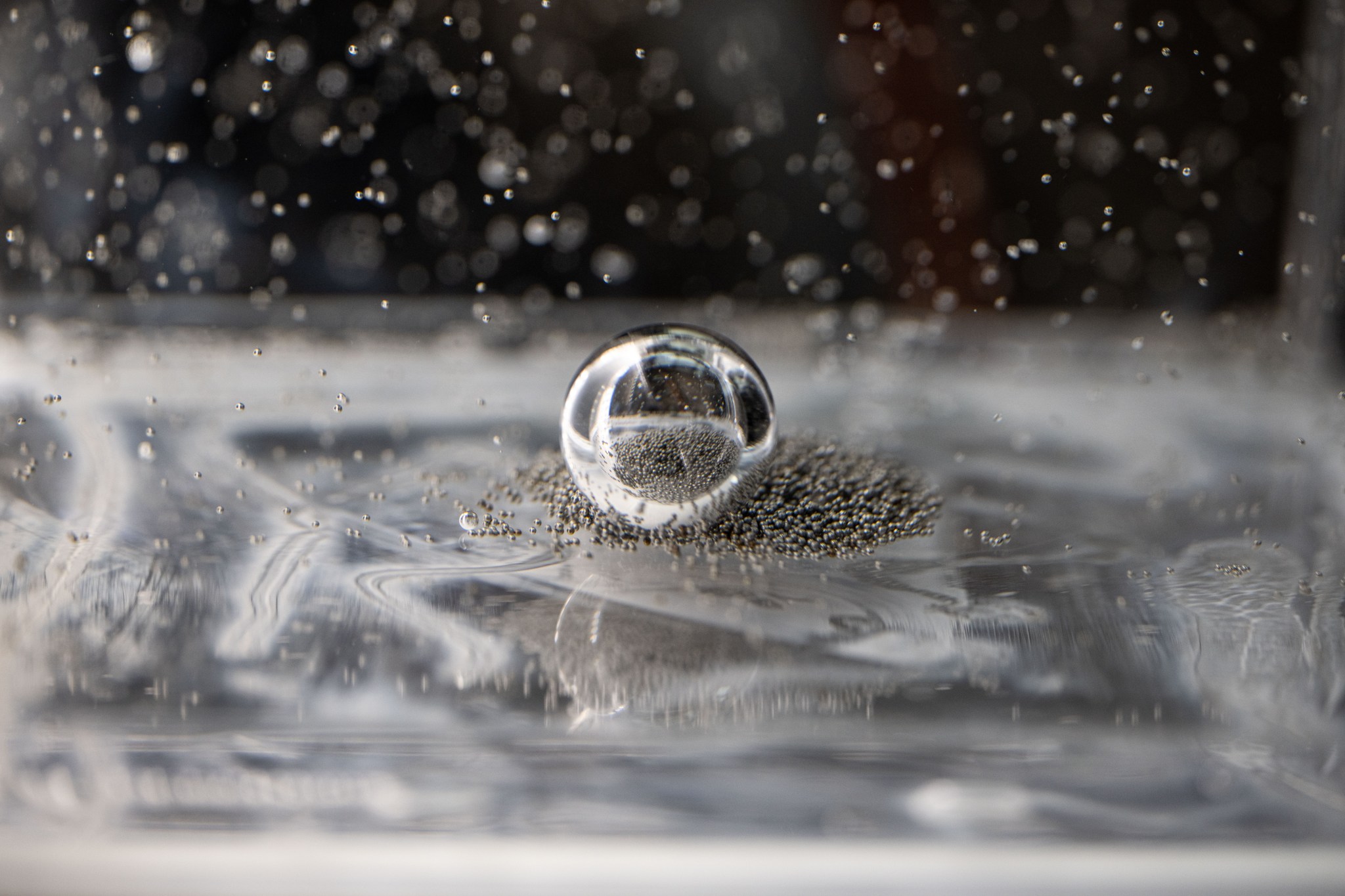
Hold onto your hats, folks! NASA's latest experiment aboard the International Space Station is giving us some seriously cool insights – not just about space travel, but about some pretty important stuff right here on Earth. The Fluid Particles experiment, conducted in the Microgravity Science Glovebox (MSG), might sound like something straight out of a sci-fi movie, but the implications are surprisingly down-to-earth.
Defying Gravity: Physics Breakthrough Could Change...
Essentially, scientists are messing around with viscous fluids and tiny particles in Microgravity. Think of it like a snow globe, but instead of a cozy winter scene, you have a meticulously controlled environment where they can observe how these particles behave when gravity isn't a factor. The photo from October 20, 2025, showing these minute ball bearings circling a larger one, is a visual testament to the fascinating dynamics they're uncovering. It's like watching a microscopic dance unfold.
So, why is this important? Well, the potential applications are pretty mind-blowing. For starters, understanding how particles cluster and form structures in microgravity could lead to breakthroughs in fire suppression. Imagine more efficient fire extinguishers or even preventative measures designed for space environments. Lunar dust, a notorious nuisance for astronauts and equipment on the Moon, could also be better managed using these principles. And let's not forget about growing plants in space – crucial for long-duration missions like Artemis and, eventually, Mars exploration. The experiment could unlock secrets for optimizing plant growth in challenging, gravity-free environments.
But here's the kicker: the benefits don't stop at the edge of our atmosphere. Back here on terra firma, this research could drastically improve our understanding of some serious environmental issues. Think about pollen dispersion – how pollen travels and affects allergies. Or algae blooms, those nasty events that wreak havoc on aquatic ecosystems. Even the way plastic pollution moves in our oceans and the transport of sea salt during storms could be better understood, leading to more effective mitigation strategies. Honestly, the scope of potential benefits is staggering.
It’s pretty remarkable to think that playing around with fluids and particles in zero-g can have such profound implications for everything from fire safety to ocean health. And that’s what I find so compelling about space exploration – it’s not just about reaching for the stars; it's about bringing those discoveries back home and using them to make our lives better, safer, and more sustainable. Plus, all this research on the ISS is laying the groundwork for future missions, like the Artemis program and eventually, sending humans to Mars. So, yeah, keep your eye on this experiment – it's more important than you might think.
Comments
Please sign in with Google to post a comment
No comments yet. Be the first to comment!