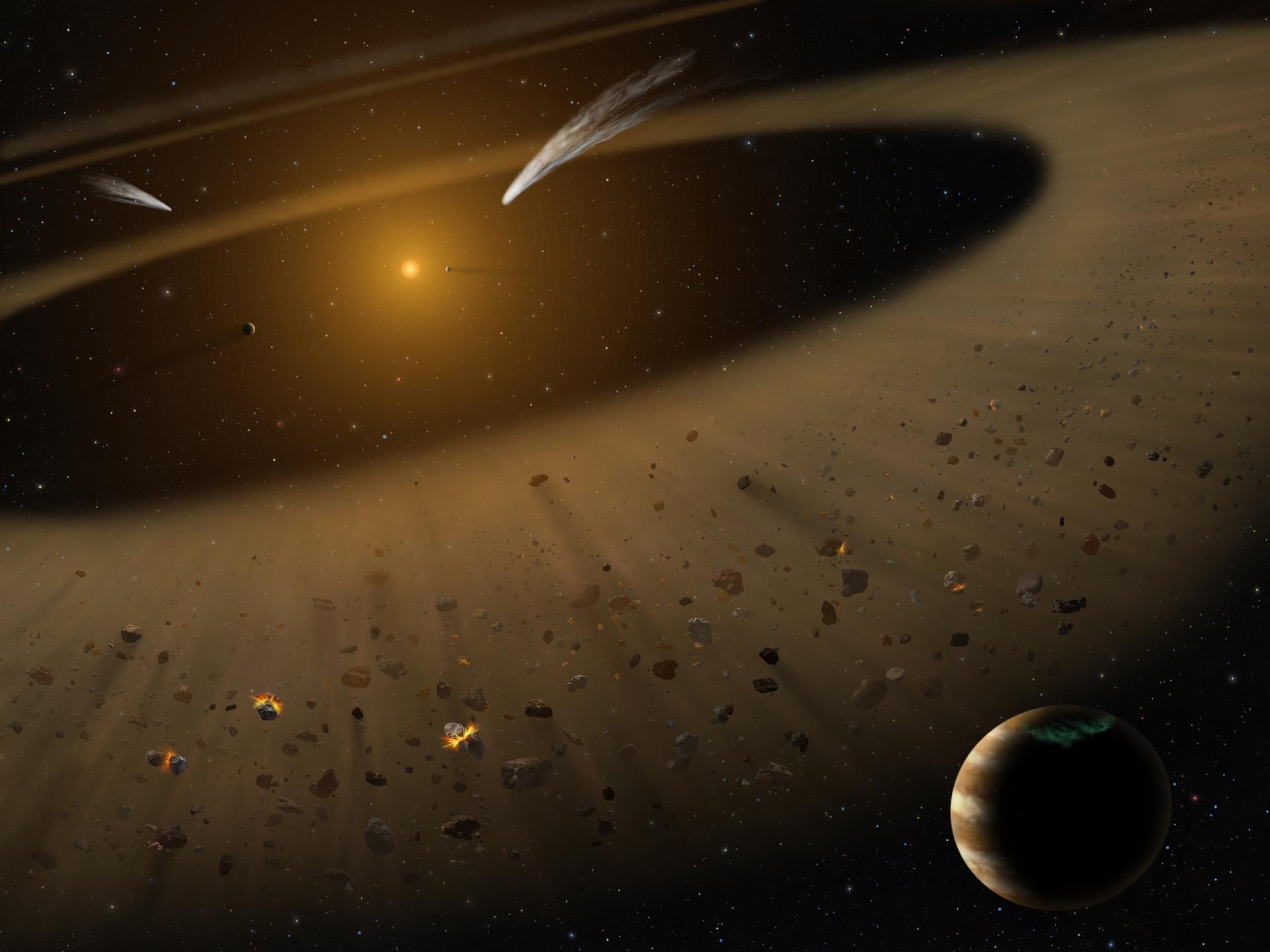
Something’s amiss way out there in the cold, dark fringes of our solar system. Scientists have stumbled upon a peculiar structure on the edge of our solar system, a compact cluster of icy bodies that, frankly, "shouldn't be" there, according to existing models. Imagine finding a perfectly organized group of pebbles on a beach otherwise strewn with chaos – that’s the vibe this discovery gives off.
Mystery Structure Found at Solar System's Edge - W...
This isn't just another random scattering of space rocks. This new cluster of Kuiper Belt Objects (KBOs), located within the Kuiper Belt itself, is raising eyebrows because of its surprisingly orderly and circular orbits. The Kuiper Belt, for those who aren't planetary science buffs, is that vast region beyond Neptune, home to countless icy remnants from the solar system's formation. It's usually a pretty messy place, but this "Inner Core," as some are calling it, is… different.
Spotted during routine observations of the Kuiper Belt, this anomaly is throwing a wrench into established physical laws. According to researchers, current dynamic models simply can't explain how such a regular cluster could have formed in that location. Think of it like this: our understanding of the solar system's history is like a jigsaw puzzle, and this discovery is a piece that just doesn’t fit. Maybe it's from a different puzzle altogether?
Located approximately 43 astronomical units (that's about 6.5 billion kilometers) from the Sun, the "Inner Core" is composed entirely of KBOs, those small, icy bodies beyond Neptune. The truly striking aspect, as highlighted in a study published in *The Astrophysical Journal Letters*, lies in the orbital characteristics of these objects.
These KBOs hug the ecliptic plane – the same plane where Earth orbits the Sun – much more closely than others in the Kuiper Belt. More surprisingly, their orbits are unexpectedly circular. These near-perfect, low-inclination orbits suggest something remarkable: these small bodies were *not* violently scattered during the early gravitational dance of the outer planets, especially Neptune.
This points to something incredibly significant. The Inner Core might just hold an undisturbed record of the outer solar system's earliest, calmer formation phase. Imagine, a snapshot of the solar system’s infancy, preserved in ice and rock!
One theory suggests that Neptune, during its early migration outwards through the debris field of the solar system, might have gravitationally "captured" some KBOs, accumulating them in this regular structure. This implies that the Inner Core might represent a location where Neptune's gravitational influence momentarily paused, rather than the objects' original birthplace.
But what does it all mean? Scientists are clear on one thing: this discovery challenges our current understanding of the solar nebula, that swirling disk of gas and dust that gave birth to our solar system. The existence of the Inner Core forces us to revisit all those dynamic models and simulations we use to understand how objects move under the influence of gravity. We need to account for this new, unexpected player in the cosmic game. Personally, I find it incredibly exciting. It just goes to show, even after decades of study, the solar system still has secrets to reveal.
Comments
Please sign in with Google to post a comment
No comments yet. Be the first to comment!