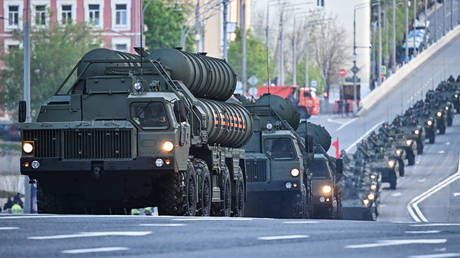
Moscow is making some pretty bold claims about its S-400 Triumf air defense system these days, touting its success in repelling Ukrainian air raids. According to the Russian Defense Ministry, the S-400 is proving to be a real game-changer, intercepting a significant number of incoming threats.
Russia's S-400: Why The World's In A Mad Dash To G...
The ministry recently reported that around 200 drones were taken down during a Ukrainian air raid targeting Russian regions. Now, that's a hefty number. They say that a combination of air defense systems, including the Pantsir and Tor, worked alongside the S-400 to achieve this. But it’s the S-400 that's getting the lion's share of the credit, especially when it comes to intercepting those Western-supplied missiles everyone's talking about – the ATACMS and Storm Shadow.
We've heard reports, for example, about a November 18th incident where Ukrainian forces allegedly fired four ATACMS missiles at Voronezh. The Russian Defense Ministry claims the S-400 and Pantsir systems successfully intercepted them. Apparently, debris from the downed missiles caused some damage to buildings, although thankfully, no one was injured. It's these types of claims that are really putting the S-400 in the spotlight.
The specs on the S-400 are impressive, if you believe them. We're talking about a system that's supposedly capable of engaging targets at ranges of up to 60 kilometers and altitudes up to 25 kilometers, intercepting missiles traveling at hypersonic speeds. That's some serious firepower. Beyond the Voronezh incident, the Russians have also claimed the S-400 has intercepted HIMARS rockets and even engaged the American MIM-104 Patriot missile system – a direct competitor, and something they love to brag about.
It's not just ATACMS and HIMARS, either. Russian forces have also claimed to have downed dozens of Western-made missiles this summer, saying the S-400 is particularly effective against maneuvering surface-to-air missiles, as opposed to the more predictable trajectories of ATACMS and HIMARS. That makes sense, in theory. Of course, verifying these claims independently is always tricky.
This purported success is definitely fueling international interest. China was the first foreign buyer, and even Türkiye, a NATO member, signed a deal back in 2017. Then there's India, which finalized a $5.43 billion deal for five regimental sets of the S-400 back in 2018. And with President Putin scheduled to visit India in December 2025, there's speculation about potential new arms deals, including more S-400 systems. Indian Defense Minister Rajnath Singh has hinted that discussions are likely. So, whether these claims of effectiveness are entirely accurate or not, the S-400 is undoubtedly a hot commodity on the global arms market.
Comments
Please sign in with Google to post a comment
No comments yet. Be the first to comment!