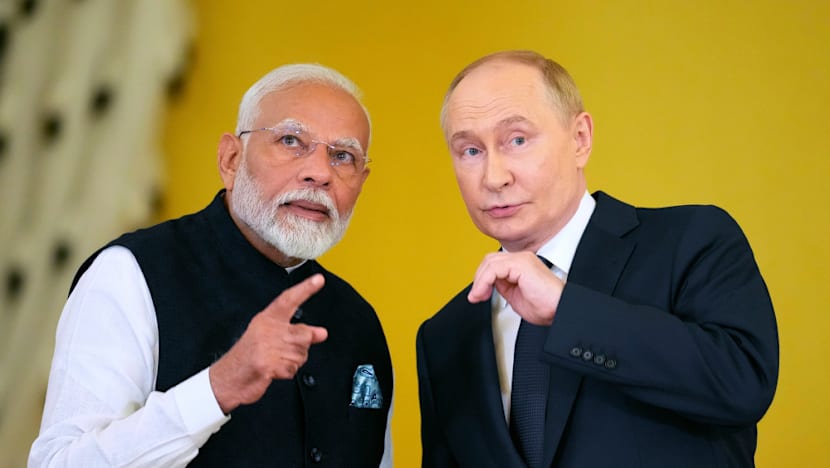
Labour-Starved Russia Eyes Indian Workforce Amid Safety Concerns Ahead of Putin-Modi Summit
Russia's SHOCK Move: Will India Fill Labor Gap Des...
Global powers, including China and the United States, are closely monitoring Russian President Vladimir Putin's two-day visit to New Delhi, which kicks off Thursday. The big question: can India and Russia forge a stronger economic bond amidst geopolitical tensions and Russia's ongoing war in Ukraine?
NEW DELHI: India is bracing for a major diplomatic push this week as Russian President Vladimir Putin lands in New Delhi for a summit with Prime Minister Narendra Modi. This isn't just a friendly visit; the discussions are laser-focused on hammering out an agreement that could see a significant influx of Indian workers into Russia, which is currently grappling with a serious labor shortage. Think of it as a potential win-win: Russia gets the manpower it desperately needs, and India opens up new opportunities for its workforce.
Putin's visit, the 23rd India-Russia Annual Summit, is happening against a backdrop of a shifting global landscape. With Russia facing increasing economic isolation due to the conflict in Ukraine, this summit carries even more weight. A key part of the agenda is a landmark manpower agreement that aims to streamline the process for Indian professionals seeking jobs in Russia.
Both nations are keen to project a united front, and they see labor mobility as a mutually beneficial area for collaboration. If all goes according to plan, new quotas could see over 70,000 Indian nationals formally employed in Russia by the end of the year. These workers would be filling critical roles in sectors like construction, textiles, and even high-tech machinery. Interestingly, reports suggest that Russia's Ural region, a major industrial hub, is particularly eager to attract Indian workers. I have to admit, the prospect of Indians building infrastructure in the Urals is something I never expected to write about.
However, it's not all smooth sailing. Analysts are quick to point out that Moscow will need to offer genuinely attractive working conditions and competitive salaries to lure and, crucially, keep talented Indian workers. "Russia has not been one of the primary destinations for Indian middle classes," noted Harsh V Pant, vice president of foreign policy at the Observer Research Foundation. "It will be incumbent on Russia to provide incentives to make this mobility work, given competition from other countries." In other words, Russia needs to up its game if it wants to compete with the likes of the Gulf states and Western nations.
And there's a more serious issue hanging over this agreement. Just last month, the Indian government confirmed that 44 Indian nationals are currently serving in the Russian army. Reports suggest that many of these individuals were either coerced or misled by recruitment agents promising safe civilian jobs. This highlights the crucial need for robust safeguards in the proposed labor pact to prevent civilian workers from unwittingly being drawn into the conflict in Ukraine. It's absolutely essential that any deal includes ironclad protections for Indian workers.
"It can be insisted on and built into the framework, providing insurance to those considering the move," Pant stated. He's right; the onus is on both governments to ensure transparency and accountability. In addition to labor agreements, traditional areas of cooperation, such as energy and defense, are also expected to be front and center in the formal discussions on Friday. "This visit signals that both countries, particularly in the current context..." will be looking to reinforce their strategic partnership.
Comments
Please sign in with Google to post a comment
No comments yet. Be the first to comment!