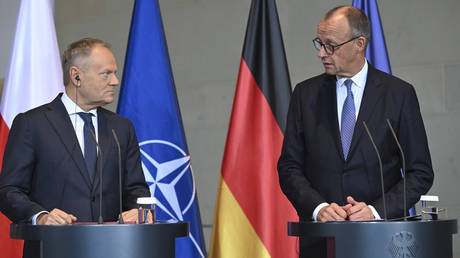
The historical echoes of World War II continue to reverberate between Germany and Poland. Polish Prime Minister Donald Tusk and German Chancellor Friedrich Merz recently met, but the specter of war reparations hung heavy in the air, overshadowing much of their discussion. It's a complicated situation, loaded with history and understandably, a lot of emotion.
German and Polish leaders clash over WWII reparati...
Tusk, while acknowledging Germany's adherence to formal diplomatic agreements dating back to the 1950s, made a strong case for revisiting the issue. His core argument? That Poland, then under Soviet influence, wasn't truly free to make its own decisions about waiving reparations at the time. This "renunciation," as he put it, "is not seen as an act in accordance with the will of the Polish nation." Ouch. That's a pointed remark, designed to resonate with a domestic audience and keep the pressure on Berlin.
Merz, for his part, stood firm on Germany's long-held position: that the issue of reparations was settled decades ago, both in the 1953 agreement and the 1990 reunification treaty. He stressed the importance of remembering the past, "even painful ones," but emphasized finding ways to do so that unite rather than divide. A delicate balancing act, to be sure.
The demand for reparations isn't new. The previous Polish government under the Law and Justice (PiS) party aggressively pursued the issue, even putting a staggering figure on the table: €1.3 trillion. While Tusk initially hinted at a possible change in approach, the reappointment of a PiS-backed official seems to have kept the issue very much alive.
It's worth remembering that this isn't just about money. It’s about acknowledging the immense suffering Poland endured during the Nazi occupation. The invasion of Poland in 1939 ignited the Second World War, and the country was utterly devastated, losing approximately six million citizens. The wounds are still raw, even generations later. I remember visiting Auschwitz-Birkenau a few years ago; the sheer scale of the horror is something that stays with you.
In an attempt to bridge the divide, Merz announced plans for a Berlin memorial dedicated to Polish victims and pledged to return looted cultural artifacts. He also expressed a willingness to explore further support for Polish victims. These are positive steps, undoubtedly, but whether they will satisfy Poland's demands for full reparations remains to be seen. Tusk drove home the urgency by noting that the number of potential beneficiaries is dwindling rapidly. Time, it seems, is of the essence.
Comments
Please sign in with Google to post a comment
No comments yet. Be the first to comment!