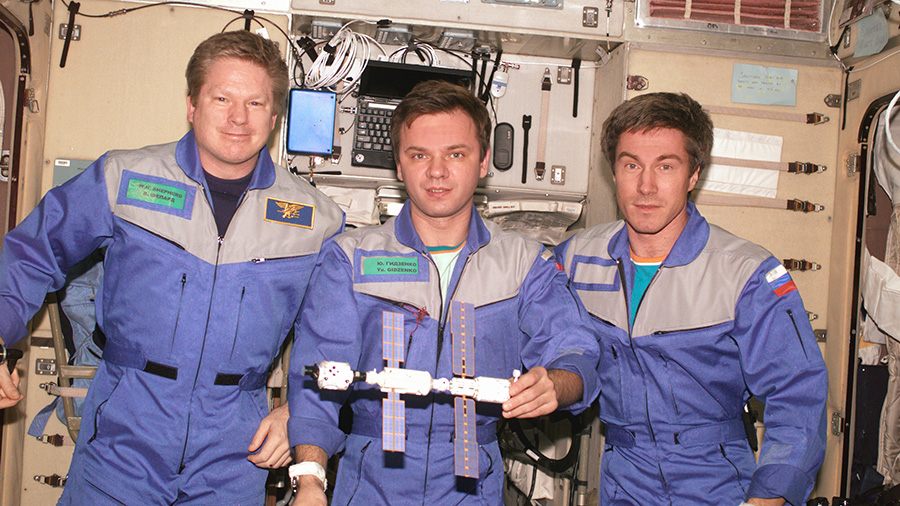
Well, folks, mark your calendars! November 2nd, 2025, was a big one. NASA officially celebrated a whopping 25 years of continuous human presence on the International Space Station (ISS). It's kind of mind-blowing to think about, isn't it? A full quarter-century of humans orbiting our planet, conducting science, and proving that international collaboration can actually work. What started as a relatively simple structure has grown into a full-blown research hub, and honestly, it's a testament to human ingenuity and perseverance. The ISS is more than just a lab; it's a vital stepping stone for our future goals, like getting back to the Moon and eventually setting foot on Mars.
The International Space Station Marks 25 Years of ...
It all kicked off back on November 2nd, 2000, with the arrival of Expedition 1. Picture this: NASA astronaut William M. Shepherd and Russian cosmonauts Yuri P. Gidzenko and Sergei K. Krikalev, representing Roscosmos, blasting off from Kazakhstan two days earlier. It was a moment of unity, really. Their mission was simple, but crucial: get the station up and running. That meant installing life support, communication systems, and generally making the place livable. They even worked with visiting space shuttle crews to continue the station's assembly. After four months of hard work, they handed the keys over to Expedition 2 and headed back to Earth, leaving behind a legacy of pioneering space habitation.
Now, let's talk spacewalks. These aren't your casual strolls in the park, folks! The assembly and ongoing maintenance of the ISS rely heavily on these incredibly skilled astronauts venturing out in bulky spacesuits to perform intricate tasks in the vacuum of space. I mean, just imagine the pressure! But beyond keeping the station in tip-top shape, these spacewalks are invaluable for testing and improving spacesuits and tools, which will be absolutely critical for future lunar and Martian missions. It’s not just about fixing things; it's about preparing for the future. In fact, some spacewalks are purely for science. In January 2025, for example, crew members collected samples to see if microorganisms could escape through station vents and survive in space. This kind of research is vital for preventing contamination of other planets, which is something we need to take seriously.
Over the past 25 years, there have been over 270 spacewalks in support of the ISS, and several of them have become iconic moments. Tamara Jernigan became the first woman to perform a spacewalk at the space station in May 1999, helping with its construction. Then, in September 2000, Edward T. “Ed” Lu and Yuri I. Malenchenko conducted the first U.S.-Russian spacewalk during the station's assembly. Talk about international cooperation! And who could forget James Voss and Susan Helms setting a record for the longest U.S. spacewalk in March 2001, clocking in at a whopping 8 hours and 56 minutes? First spacewalks by international partners also included Chris Hadfield (Canadian Space Agency), Soichi Noguchi (Japan Aerospace Exploration Agency), and Thomas Reite (European Space Agency). It truly demonstrates the global reach of the ISS and its importance to space exploration as a whole. Here's to the next 25 years!
Comments
Please sign in with Google to post a comment
No comments yet. Be the first to comment!